

How To Create Soap Webservices In Java
-
Release Information
- About...
-
Release Notes
- New and Enhanced Features for InterSystems IRIS 2021.1
- General Upgrade Information
- Upgrade Compatibility Checklist for InterSystems IRIS 2021.1
- Known Issues and Notes
- Deprecated and Discontinued Features
- Licensing and Use of InterSystems Web Server
-
Supported Platforms
- Supported Technologies
- Supported Languages
- Discontinued Platforms and Technologies
- Supported Version Interoperability
- Cross-Product Technology Matrix
- First Looks
- Downloading Samples
- Searching the Documentation
-
Deployment
- About...
-
Containers
- About...
- First Look
- Try a Community Edition Container
- Running in Containers
-
InterSystems Cloud Manager
- About...
- InterSystems Cloud Manager
-
InterSystems Cloud Manager Guide
- ICM Overview
- Essential InterSystems Cloud Manager Elements
- Using InterSystems Cloud Manager
- ICM Reference
- Containerless Deployment
- Sharing ICM Deployments
- Scripting with ICM
- Using ICM with Custom and Third-Party Containers
- Deploying on a Preexisting Cluster
-
InterSystems Kubernetes Operator
- About...
- Using the InterSystems Kubernetes Operator
-
Installation Kit
- About...
- Installation Basics
-
Installation Guide
- Preparing to Install InterSystems IRIS
- Installing InterSystems IRIS on Microsoft Windows
- Installing InterSystems IRIS on UNIX®, Linux, and macOS
- Upgrading InterSystems IRIS
- Creating and Using an Installation Manifest
- Adding UNIX® Installation Packages to an InterSystems IRIS Distribution
-
Configuration
- About...
- Automating Configuration
-
Configuration Parameters
- Introduction to the Configuration Parameter File
- [Actions]
- [ComPorts]
- [config]
- [ConfigFile]
- [Databases]
- [Debug]
- [Devices]
- [DeviceSubTypes]
- [ECP]
- [ECPServers]
- [Gateways]
- [IO]
- [Journal]
- [LicenseServers]
- [Map]
- [MapMirrors]
- [MirrorMember]
- [Mirrors]
- [Miscellaneous]
- [Monitor]
- [Namespaces]
- [SQL]
- [SqlSysDatatypes]
- [SqlUserDatatypes]
- [Startup]
- [Telnet]
-
Data Migration
- About...
- Server Migration
-
ISQL Migration Guide
- Overview
-
Transact-SQL (TSQL) Migration Guide
- Planning and Performing TSQL Migration
- InterSystems TSQL Constructs
- InterSystems TSQL Language Elements
- TSQL Commands
- TSQL Settings
- TSQL Functions
- TSQL Variables
- TSQL System Stored Procedures
- DataMove
- Adding Compiled Code
-
Administration
- About...
-
System Administration
- Using the Management Portal
- Configuring InterSystems IRIS
- Managing InterSystems IRIS
- Managing InterSystems IRIS Licensing
- Using InterSystems IRIS on Windows
- Using InterSystems IRIS on UNIX®, Linux, and macOS
- Connecting to Remote Servers
- Using Multiple Instances of InterSystems IRIS
- Configuring Third-Party Software to Work in Conjunction with InterSystems Products
- Feature Tracker Collects Usage Statistics
-
Monitoring
- About...
-
Monitoring Guide
- Monitoring InterSystems IRIS Using the Management Portal
- Using the InterSystems Diagnostic Report
- Using Log Monitor
- Using System Monitor
- Gathering Global Activity Statistics Using ^GLOSTAT
- Monitoring System Performance Using ^PERFMON
- Monitoring Routine Performance Using ^PROFILE
- Examining Routine Performance Using ^%SYS.MONLBL
- Monitoring Block Collisions Using ^BLKCOL
- Monitoring Performance Using ^SystemPerformance
- Monitoring Performance Using ^mgstat
- Monitoring Processes Using ^PERFSAMPLE
- History Monitor
- Monitoring InterSystems IRIS Using SNMP
- Monitoring InterSystems IRIS Using Web Services
- Monitoring InterSystems IRIS Using REST API
- Monitoring InterSystems IRIS Using the irisstat Utility
-
Error Reference
- General Error Messages
- SQL Error Messages
- TSQL Error Messages
- System Error Messages
- Messages Related to Productions
- System Alerting and Monitoring Application
-
Specialized System Tools and Utilities
- Introduction
- Using System Classes for National Language Support
- Customizing Start and Stop Behavior with ^%ZSTART and ^%ZSTOP Routines
- Extending Languages with ^%ZLANG Routines
- Controlling InterSystems IRIS from a Windows Client
- Using ^GBLOCKCOPY for Fast Global Copies
- Using Switches
- Notes on Managing InterSystems IRIS via Routines
- Process Management
- Using cvendian for Byte Order Conversion
-
Architecture
- About...
-
Mirroring and High Availability
- About...
- High Availability Solutions
-
High Availability Guide
- Failover Strategies for High Availability
- Mirroring Overview
- Mirroring Architecture and Planning
- Configuring Mirroring
- Managing Mirroring
- Mirror Outage Procedures
-
Scalability
- About...
-
First Looks
- Scaling for User Volume
- Scaling for Data Volume
-
Scalability Guide
- InterSystems IRIS Scalability Overview
- Vertically Scaling InterSystems IRIS
- Horizontally Scaling for User Volume with Distributed Caching
- Horizontally Scaling for Data Volume with Sharding
-
Resiliency and Data Integrity
- About...
- First Look
-
Data Integrity Guide
- Introduction to Data Integrity
- Write Image Journaling and Recovery
- Backup and Restore
- Journaling
- Data Consistency on Multiple Systems
-
Security
- About...
- About InterSystems Security
- System Management & Security
-
Securing Your Instance
- Security Strategy
- Prepare for InterSystems Security
- Tighten Security for an Instance
- Security Advisor
- Secure InterSystems Processes and Operating-System Resources
- Checklist for Hardening Your Deployment
-
Security Tutorial
-
Authentication
- Authentication Mechanisms
- InterSystems Authentication Components and Process
- Connection Tools and Access Modes
- InterSystems Services
- Specifying Authentication Mechanisms
- Two-Factor Authentication
- Users
- Predefined Users
- Cascading Authentication
- Kerberos Authentication
- Operating System Based Authentication
- Instance Authentication
- Example One: %Service_Console
- Example One: %Service_Console (cont.)
- Example One: %Service_Console (cont.)
- Example One: %Service_Console (cont.)
- Example Two: Web
- Example Two: Web (cont.)
- Delegated Authentication
- Delegated Authentication Setup
- ZAuthenticate
- LDAP Authentication
- LDAP Authentication Configuration
- Recap
-
Authorization
- Overview
- Assets and Resources
- Privileges
- Public Privileges
- Privileges, Roles, and Users
- Database Resources
- Namespaces
- Example Setup
- Example One: %Developer and %Operator Roles
- Example Two: %Development Resource
- Example Three: %DB_USER Resource
- Example Four: $SYSTEM.Security.Check
- Recap
-
Securing Applications
- Overview
- Three Types of Application Definitions
- Properties of Application Definitions
- Web Application Definitions
- Example Setup
- Example Setup (cont.)
- Example One: Disabling an Application
- Example Two: Protecting an Application with a Resource
- Example Three: Application Roles
- Example Four: Matching and Target Roles
- Privileged Routine Applications
- Example Setup
- Example Setup (cont.)
- Example: Creating a Privileged Routine Application Definition
- Example: Adding a Routine
- Example: Adding Application Roles
- Example: Executing the Privileged Routine Application
- Java, .NET, and Other Applications
- Recap
- Connection Tools, Access Modes, Services
- Code for Authorization Example
- Code for Authentication Example
- Code for Privileged Routine Example
- Creating a User
- Creating a Resource
- Creating a Role
- Adding a User to a Role
-
Security for Developers
- About...
-
SOAP Security
- Introduction
- Setup and Other Common Activities
- Creating and Using Policies
- WS-Policy Configuration Class Details
- Adding Security Elements Manually
- Adding Timestamps and Username Tokens
- Encrypting the SOAP Body
- Encrypting Security Header Elements
- Adding Digital Signatures
- Using Derived Key Tokens for Encryption and Signing
- Combining Encryption and Signing
- Validating and Decrypting Inbound Messages
- Creating Secure Conversations
- Using WS-ReliableMessaging
- Creating and Adding SAML Tokens
- Troubleshooting Security Problems
- Details of the Security Elements
- SQL Security
- Command-Line Security Utilities
-
Authentication and Authorization
- About...
-
First Looks
- Role-Based Access Control
- LDAP
-
Authentication Guide
- Introduction
- Kerberos Authentication
- Operating System–Based Authentication
- Instance Authentication
- Delegated Authentication
- Two-Factor Authentication
- Services
- Advanced Topics
-
Authorization Guide
- About InterSystems Authorization
- Assets and Resources
- Privileges and Permissions
- Roles
- User Accounts
- Applications
- Using Delegated Authorization
-
LDAP Guide
- LDAP and InterSystems IRIS®
- LDAP Authentication
- LDAP Authorization
- Other LDAP Topics
-
OAuth 2.0 & OpenID Connect
- Overview of OAuth 2.0 and OpenID Connect
- How InterSystems IRIS Supports OAuth 2.0 and OpenID Connect
- Using an InterSystems IRIS Web Application as an OAuth 2.0 Client
- Using an InterSystems IRIS Web Application as an OAuth 2.0 Resource Server
- Using InterSystems IRIS as an OAuth 2.0 Authorization Server
- Creating Configuration Items Programmatically
- Implementing DirectLogin()
- Certificates and JWTs (JSON Web Tokens)
-
Encryption
- About...
-
First Looks
- Database Encryption
- Public Key Infrastructure
- Public Key Infrastructure
-
Encryption Guide
- About Managed Key Encryption
- Key Management Tasks
- Using Encrypted Databases
- Using Data-Element Encryption
- Protecting Against Data Loss
- Handling Emergency Situations
- Additional Encryption Information
- FIPS 140–2 Compliance for Database Encryption
- Cryptographic Standards
-
TLS Guide
- About TLS
- About Configurations
- Configuring the InterSystems IRIS Superserver to Use TLS
- Configuring InterSystems IRIS Telnet to Use TLS
- Configuring Java Clients to Use TLS with InterSystems IRIS
- Configuring .NET Clients to Use TLS with InterSystems IRIS
- Configuring Studio to Use TLS with InterSystems IRIS
- Connecting from a Windows Client Using a Settings File
- Configuring InterSystems IRIS to Use TLS with Mirroring
- Configuring InterSystems IRIS to Use TLS with TCP Devices
- Configuring the Web Gateway to Connect to InterSystems IRIS Using TLS
- Establishing the Required Certificate Chain
- Auditing Guide
-
Embedded Language Development
- About...
- Data Model
-
Orientation Guide
- Introduction to InterSystems IRIS Programming
- A Closer Look at ObjectScript
- Classes
- Objects
- Persistent Objects and InterSystems IRIS SQL
- Namespaces and Databases
- InterSystems IRIS Security
- Localization Support
- Server Configuration Options
- What's That?
- Rules and Guidelines for Identifiers
- General System Limits
- Numeric Computing in InterSystems Applications
-
Globals
- About...
- First Look
- Multidimensional Data Access
-
Using Globals
- Introduction
- Global Structure
- Using Multidimensional Storage (Globals)
- SQL and Object Use of Multidimensional Storage
- Managing Globals
- Temporary Globals and the IRISTEMP Database
-
ObjectScript
- About...
- First Look
-
ObjectScript IDEs
- Connecting an IDE
- About Visual Studio Code
-
Using Studio
- Introduction to Studio
- Creating Class Definitions
- Adding Properties to a Class
- Adding Methods to a Class
- Adding Class Parameters to a Class
- Adding Relationships to a Class
- Adding Queries to a Class
- Adding Indices to a Class
- Adding Projections to a Class
- Adding XData Blocks to a Class
- Adding SQL Triggers and Foreign Keys to a Class
- Adding Storage Definitions to a Class
- Working with CSP Files
- Working with Routines and Include Files
- Using the Studio Debugger
- Using Studio Templates
- Studio Menu Reference
- Setting Studio Options
- Frequently Asked Questions About Studio
- Source Control Integration
-
Using Terminal
- Introduction to the Terminal
- Using the Terminal Interactively
- Controlling the Appearance and Behavior of the Terminal
- Using Terminal Scripts
- Script Command Reference
- Connecting to Remote Hosts
- Using the Terminal in Batch Mode
- Advanced Topics
- Object Data Access
-
Using ObjectScript
- Introducing ObjectScript
- Syntax Rules
- Data Types and Values
- Variables
- Operators and Expressions
- Regular Expressions
- Commands
- Callable User-defined Code Modules
- ObjectScript Macros and the Macro Preprocessor
- Embedded SQL
- Multidimensional Arrays
- String Operations
- Lock Management
- Transaction Processing
- Error Processing
- Command-line Routine Debugging
-
Class Definitions
- About...
-
Defining & Using Classes
- Basic Ideas in Class Programming
- Defining and Compiling Classes
- Package Options
- Defining and Referring to Class Parameters
- Defining and Calling Methods
- Working with Registered Objects
- Introduction to Persistent Objects
- Working with Persistent Objects
- Defining Persistent Classes
- Defining and Using Literal Properties
- Working with Collections
- Working with Streams
- Defining and Using Object-Valued Properties
- Defining and Using Relationships
- Other Options for Persistent Classes
- Defining Method and Trigger Generators
- Defining and Using Class Queries
- Defining and Using XData Blocks
- Defining Class Projections
- Defining Callback Methods
- Using and Overriding Property Methods
- Defining Data Type Classes
- Implementing Dynamic Dispatch
- Object-Specific ObjectScript Features
- Using the Populate Utility
- Using the %Dictionary Classes
- Using the Object Synchronization Feature
-
Class Definition Reference
- Class Definitions
- Class Keywords
- Foreign Key Keywords
- Index Keywords
- Method Keywords
- Parameter Keywords
- Projection Keywords
- Property Keywords
- Query Keywords
- Trigger Keywords
- XData Keywords
- Storage Keywords
- Classes Page
-
ObjectScript Reference
- Symbols and Abbreviations
- ObjectScript Commands
- Routine and Debugging Commands
- ObjectScript Functions
- ObjectScript Special Variables
- Structured System Variables
-
ObjectScript Tutorial
-
The Basics
- Introduction
- Class Methods
- Terminal
- VS Code - ObjectScript
- Do Command
- Class Methods and Routines
- Method Details
- Passing Arguments by Reference
- Return and Quit Commands
- Write Command
- Read Command
- Set Command
- Operator Precedence
- Syntax
- Common Errors
- Write (again) and Kill Commands
- If Construct
- Simple Conditions
- Complex Conditions
- Hands-On Exercise 1
- Class Compilation
- Controlling Execution Flow
- $Case Function
- For Construct
- While and Do/While Constructs
- Try/Catch Construct, and Throw Command
- Multiple Purpose Characters
- Hands-On Exercise 2
- Recap of Part 1
-
The Good Stuff
- Strings
- Storing a String
- Concatenation Operator
- Pattern Matching and Regular Expressions
- Pattern Matching Examples
- String Functions
- String Functions, continued
- Lists
- Compare Pieces and Lists
- Setting Substrings, Pieces, and List Items
- More List Functions
- Bitstrings
- Dates
- Hands-On Exercise 3
- JavaScript Object Notation (JSON)
- Arrays
- Ordered Trees
- Ordered Trees, continued
- Value and Existence, and the $Data Function
- Viewing and Killing Arrays
- Globals
- $Increment and $Sequence Functions
- Storage Method
- Storage Method, continued
- Example of Globals
- Hands-On Exercise 4
- Recap of Part 2
-
Using Globals
- $Order Function
- $Order Function, continued
- Working With Indexes
- $Order Loop
- Nested $Order Loops
- Starting Focused $Order Loops
- Ending Focused $Order Loops
- Hands-On Exercise 5
- Conversion Functions
- $Get Function
- Hands-On Exercise 6
- Database Integrity
- Lock Command
- Lock Command, continued
- Lock Command and $Test
- Transaction Processing
- Hands-On Exercise 7
- InterSystems IRIS Objects and SQL
- Object Methods
- Object Storage
- SQL Queries
- Recap Of Part 3
-
RightTriangle Example Class and Exercise Solutions
- Right Triangle Example Class
- Exercise 1: First Data Entry Class
- Exercise 2: Second Data Entry Class
- Exercise 3: Third Data Entry Class
- Exercise 4: Storage Method
- Exercise 5: First Lookup Class
- Exercise 6: Second Lookup Class
- Exercise 7: Third Lookup Class
- %Status Values
- Try-Catch
- Finding Class References
-
InterSystems API Manager (IAM)
- About...
- First Look
-
SQL
- About...
-
First Looks
- InterSystems SQL
- Optimizing SQL Performance
-
Using SQL
- Introduction to InterSystems SQL
- InterSystems SQL Basics
- Language Elements
- Identifiers
- Defining Tables
- Defining and Using Views
- Relationships Between Tables
- Modifying the Database
- Querying the Database
- Collation
- Implicit Joins (Arrow Syntax)
- Using Embedded SQL
- Using Dynamic SQL
- Using the SQL Shell Interface
- Using the Management Portal SQL Interface
- Importing SQL Code
- Using Triggers
- Defining and Using Stored Procedures
- Storing and Using Stream Data (BLOBs and CLOBs)
- Users, Roles, and Privileges
- Importing and Exporting SQL Data
-
Optimizing SQL
- Introduction to SQL Performance Optimization
- Defining and Building Indices
- Optimizing Tables
- Cached Queries
- Optimizing Query Performance
- SQL Performance Analysis Toolkit
- Interpreting an SQL Query Plan
- SQL Statements
- Frozen Plans
-
InterSystems SQL Reference
- Symbols and Syntax Conventions
- SQL Commands
- SQL Commands for IntegratedML
- SQL Predicate Conditions
- SQL Aggregate Functions
- SQL Window Functions
- SQL Functions
- SQL Unary Operators
- SQL Reference Material
-
Using the InterSystems SQL Gateway
- SQL Gateway Overview
- Using the InterSystems SQL Gateway
- Connecting the SQL Gateway via JDBC
- Connecting the SQL Gateway via ODBC
- Using the SQL Gateway Programmatically
-
Document Database
- Introducing InterSystems IRIS Document Database (DocDB)
- Managing Documents
- REST Client Methods
-
XML
- About...
-
XML Tools
- Introduction to InterSystems XML Tools
- Writing XML Output from Objects
- Importing XML into Objects
- Representing an XML Document as a DOM
- Encrypting XML Documents
- Signing XML Documents
- Using %XML.TextReader
- Evaluating XPath Expressions
- Performing XSLT Transformations
- Customizing How the InterSystems SAX Parser Is Used
- Generating Classes from XML Schemas
- Generating XML Schemas from Classes
- Examining Namespaces and Classes
- XML Background
-
XML Projections
- Introduction to Object-XML Projections
- Projecting Objects to XML
- Controlling Transformations of Values
- Handling Empty Strings and Null Values
- Controlling the XML Element and Attribute Names
- Specifying Namespaces for Elements and Attributes
- Controlling the Projection to XML Schemas
- Advanced Options for XML Schemas
- Special Topics
- Summary of XML Projection Parameters
-
Web Services
- About...
-
Web Gateway Configuration Guide
- Installing the Web Gateway
- Web Application Architecture
- Web Servers for Microsoft Windows
- Web Servers for UNIX, Linux, and macOS
- Web Gateway Operation and Configuration
- Alternative Configurations for Microsoft Windows
- Alternative Configurations for UNIX, Linux, and macOS
- Apache Considerations UNIX, Linux, and macOS
- Building Apache for IBM AIX®
- IIS Technical Notes
- Using Web Applications with a Remote Web Server
-
SOAP
- About...
-
Creating SOAP Web Services and Clients
- Introduction to Web Services and Web Clients in InterSystems IRIS
- Current Page: Creating SOAP Web Services
- SOAP Message Variations
- Creating Web Clients
- SOAP Fault Handling
- Using MTOM for Attachments
- Using SOAP with Attachments
- Adding and Using Custom Header Elements
- Adding and Using WS-Addressing Header Elements
- SOAP Session Management
- Using the InterSystems IRIS Binary SOAP Format
- Using Datasets in SOAP Messages
- Fine-Tuning a Web Service in InterSystems IRIS
- Fine-Tuning a Web Client in InterSystems IRIS
- Troubleshooting SOAP Problems in InterSystems IRIS
- Summary of Web Service URLs
- Details of the Generated WSDLs
- Details of the Generated Classes
-
REST and JSON
- About...
- First Look
-
REST Services
- Introduction to Creating REST Services
- Using the /api/mgmnt Service
- Using the ^%REST Routine to Create REST Services
- Using the %REST.API Class to Create REST Services
- Modifying the Implementation Class
- Modifying the Specification Class
- Supporting CORS in REST Services
- Using Web Sessions with REST
- Securing REST Services
- Discovering and Documenting REST APIs
- Reference for the /api/mgmnt API
- OpenAPI Properties in Use
- Creating a REST Service Manually
-
REST API for Source Code
- Introduction to the InterSystems IRIS Source Code File REST API
- Source Code File REST API Tutorial
- Source Code File REST API Reference
-
Using JSON
- Introduction
- Creating and Modifying Dynamic Entities
- Iteration and Sparse Arrays
- Working with Datatypes
- Using the JSON Adaptor
- Quick Reference for Dynamic Entity Methods
-
Internet Utilities
- Introduction
- Sending HTTP Requests
- Sending and Receiving Email
- Creating, Writing, and Reading MIME Messages
- Using FTP
- Sending and Receiving IBM WebSphere MQ Messages
- Using SSH
- Other InterSystems %Net Tools
-
I/O Device Guide
- About I/O Devices
- I/O Devices and Commands
- Terminal I/O
- Local Interprocess Communication
- TCP Client/Server Communication
- UDP Client/Server Communication
- Sequential File I/O
- Spool Device
- Printers
-
Advanced Concepts
- Locking & Concurrency
- Bits & Bitstrings
- Structured Logging
- Semaphores
- String Localization
- Process Memory
- Work Queue Manager
- Secure Logins
- Using %Library.File
-
%UnitTest Tutorial
-
Unit Testing Overview
- What is a Unit Test?
- Why Unit Test?
- xUnit Testing Frameworks
- Structure of %UnitTest and xUnit Frameworks
- Test Automation
- Test First Methodology
- Red – Green – Refactor
- Recap
-
Unit Testing with %UnitTest
- What is %UnitTest?
- Creating and Executing a Suite of Unit Tests
- %UnitTest Classes
- Assert Methods and Macros
- Creating Classes to Use in the Examples
- Example: Creating and Exporting a Test Class
- Example: Executing a Test
- Example: UnitTest Portal
- Example: Viewing the Report in the Unit Test Portal
- Setup and Tear Down
- Example: Adding Setup and Tear Down Methods to a Test
- Example: Executing a Test Using Setup and Tear Down Methods
- Options for Executing Tests: Test Specs and Qualifiers
- RunTest Examples
- DebugRunTestCase
- Exercises
- Recap
-
API Index
- Tools Index
-
Glossary
- Complete Glossary of Terms
-
External Language Development
- About...
- Native APIs
-
Using InterSystems External Servers
- Introduction to InterSystems External Servers
- Working with External Languages
- Managing External Server Connections
- Customizing External Server Definitions
- InterSystems External Server Requirements
- Quick Reference for the ObjectScript $system.external Interface
-
Java
- About...
-
First Looks
- Java Gateway
- Native API for Java
- Java Object Persistence with XEP
- JDBC and InterSystems Databases
-
Java Gateway
- Introduction to the Java Gateway
- Using Dynamic Object Gateways
- Using the Java Gateway in a Production
- Sample Code
- Mapping Specification
-
Using Java with InterSystems Software
- Document Overview
- InterSystems Java Connectivity Options
- Using the JDBC Driver
- Configuration and Requirements
- JDBC for Occasional Users
- JDBC Quick Reference
-
Using the Native SDK for Java
- Document Overview
- Introduction to the Java Native SDK
- Calling ObjectScript Methods and Functions
- Using Java Inverse Proxy Objects
- Working with Global Arrays
- Transactions and Locking
- Java Native SDK Quick Reference
-
Persisting Java Objects with InterSystems XEP
- Introduction
- Using XEP Event Persistence
- XEP Quick Reference
-
Implementing Third Party APIs
- Introduction
- JDBC Driver Support
- Apache Spark Support
- Hibernate Support
- JDBC
-
.NET
- About...
-
First Looks
- .NET Gateway
- Native API for .NET
- ADO.NET and InterSystems Products
- .NET Object Persistence with XEP
- ODBC and InterSystems IRIS
-
Using the Object Gateway for .NET
- Object Gateway Architecture
- Setting Object Gateway Server Properties
- Running an Object Gateway Server
- Using Dynamic Object Gateways
- Creating Static Proxy Classes
- Sample Code
- Mapping Specification
- Using the Object Gateway in a Production
-
Using .NET with InterSystems Software
- Introduction
- Connecting to the InterSystems Database
- Configuration and Requirements
- ADO.NET Managed Provider for Occasional Users
- Using the Entity Framework Provider
- Quick Reference for the .NET Managed Provider
-
Using the Native API for .NET
- Introduction to the Native API
- Calling ObjectScript Methods and Functions
- Using .NET Reverse Proxy Objects
- Working with Global Arrays
- Transactions and Locking
- Native API for .NET Quick Reference
-
Persisting .NET Objects with InterSystems XEP
- Introduction
- Using XEP Event Persistence
- XEP Quick Reference
-
ODBC
- About...
-
Using the InterSystems ODBC Driver
- Overview
- Defining an ODBC Data Source on Windows
- Defining an ODBC Data Source on UNIX®
- ODBC Installation and Validation on UNIX® Systems
- ODBC Support for Python and Node.js
- Logging and Environment Variables
-
Python
- About...
- First Look
-
Using the Native API for Python
- Introduction to the Native API
- Working with Global Arrays
- Calling ObjectScript Methods and Functions
- Native API Quick Reference for Python
-
Node.js
- About...
- First Look
-
Using the Native API for Node.js
- Introduction to the Native API
- Working with Global Arrays
- Calling ObjectScript Methods and Functions
- Native API Quick Reference for Node.js
-
Callin
- The Callin Interface
- Using the Callin Functions
- Callin Function Reference
-
Callout
- Introduction
- Running Programs or System Commands with $ZF(-100)
- Creating an InterSystems Callout Library
- Invoking Callout Library Functions
- InterSystems Callout Quick Reference
-
Interoperability Productions
- About...
- First Look
-
Introducing Interoperability Productions
- Introduction to Interoperability Productions
- Connectivity Options
- Business Processes and Business Logic
- Other Production Options
-
Preparing to Create Productions
- Road Map to Using InterSystems IRIS Productions
- Planning an InterSystems IRIS Server Deployment
-
Best Practices
- Best Practices for Production Development
- Design Model for a Routing Production
- Converting Interfaces to Production Elements
-
Developing Productions
- About...
-
Developing Productions Using ObjectScript
- Introduction
- Programming Business Services, Processes and Operations
- Defining Messages
- Defining Business Services
- Defining Business Processes
- Defining Business Operations
- Defining an Alert Processor
- Defining Data Transformations
- Defining Business Metrics
- Defining an Enterprise Message Bank
- Using the Record Mapper
- Using the Complex Record Mapper
- Handling Batches of Records Efficiently
- Less Common Tasks
- Testing and Debugging
- Deploying a Production
- Life Cycle of a Production and Its Parts
-
Developing Productions Using Java and .NET
- Introduction
- Getting Started
- About Business Hosts and Adapters
- Messaging
- Inbound Adapters
- Outbound Adapters
- Business Services
- Business Processes
- Business Operations
- Running the External Server
- PEX API Reference
-
BPL and DTL
- First Look
-
Developing BPL Processes
- About BPL Processes
- Using the Business Process Designer
- Syntax Rules
- List of BPL Elements
- Handling Errors in BPL
-
Developing DTL Transformations
- Introduction to DTL Tools
- Creating Data Transformations
- Syntax Rules
- Adding Assign Actions
- Adding Other Actions
- Testing Data Transformations
-
BPL and DTL Reference
- BPL Elements
- DTL Elements
-
Using a Production as an ESB
- Enterprise Service Bus and Registry Overview
- Intended Audiences
- Accessing the Public Service Registry through the Public REST API
- Administering the Public Service and External Service Registries
- Configuring an ESB
- Configuring ESB Services and Operations
- Configuring an InterSystems IRIS System and Creating a Namespace
- Configuring a Web Application for a Pass-through Business Service
- Pass-through Service and Operation Walkthrough
- Service Registry Public API Reference
-
Configuring, Managing, and Monitoring Productions
- About...
-
Configuring Productions
- Introduction to Configuration Tasks
- Creating a Production
- Adding Business Hosts
- Configuring Settings
- Configuring Alerts
- Defining Reusable Items for Use in Settings
- Defining Other Options for Productions
- Configuring the Enterprise Message Bank
- Identifying Enterprise Systems for Viewing and Monitoring
- Creating Dashboards
- Settings in All Productions
-
Managing Productions
- Introduction to Managing Productions
- Starting and Stopping Productions
- Purging Production Data
- Using the Archive Manager
- Managing Workflow Roles, Users, and Tasks
- Defining Publish and Subscribe Message Routing
- Controlling Data Storage for Productions
- Controlling Access to Management Portal Functions
- Finding Information on Menu Items
-
Monitoring Productions
- Core Concepts
- Monitoring All Namespaces
- Monitoring a Production
- Viewing, Searching, and Managing Messages
- Viewing the Event Log
- Enabling Tracing
- Viewing the Business Rule Log
- Viewing Business Process Instances
- Viewing the I/O Archive for a Production
- Viewing Messages from Multiple Productions
- Using the Enterprise Message Viewer
- Using the Enterprise Message Bank
- Viewing Interface Maps
- Finding Interface References
- Monitoring Alerts
- Monitoring Activity Volume
- Managing Port Usage
-
Push Notifications
- Push Notifications Overview
- Configuring and Using Push Notifications
-
Defining Workflows
- Overview of Workflow within Productions
- Developing a Workflow
- Including Custom Features in a Workflow
- Testing a Workflow
- Exploring the Workflow Sample
- Available Workflow Metrics
-
Testing Productions
- Testing Productions Tutorial
-
Testing Productions
- TestControl
- Callback Methods
- Auxiliary Methods
- Parameters and Properties
- Creating a Test - Summary
- Executing a Test
- Example Overview
- Example: Example Production
- Example: Production Test
- Example: OnAfterProductionStart
- Example: CheckResults
- Example: CheckErrors
- Example: Executing the Test
- Recap
- Creating Tutorial.ExampleOperation
-
Connecting Systems
- About...
- Supported Formats
- Supported Protocols
-
Email Adapters
- Introduction
- Using the Email Inbound Adapter
- Using the Email Outbound Adapter
- Reference for Settings
-
File Adapters
- Introduction
- Using the File Inbound Adapter
- Using the File Outbound Adapter
- Using the File Passthrough Service and Operation Classes
- Reference for Settings
-
FTP Adapters
- Introduction
- Using the FTP Inbound Adapter
- Using the FTP Outbound Adapter
- Reference for Settings
-
HTTP Adapters
- About the HTTP Adapters
- Using the HTTP Inbound Adapter
- Using the HTTP Outbound Adapter
- Reference for Settings
-
Java Messaging Service (JMS)
- JMS Overview
- Configuring and Using JMS Business Services and Operations
- Creating Custom JMS Services and Operations Using the Adapter
-
IBM WebSphere MQ Adapters
- About the IBM WebSphere MQ Adapters
- Using the IBM WebSphere MQ Inbound Adapter
- Using the IBM WebSphere MQ Outbound Adapter
- Troubleshooting
- Reference for Settings
-
MQTT Adapters
- Introduction to Message Queuing Telemetry Transport (MQTT)
- Using the MQTT Adapters
- Configuring and Using the MQTT Passthrough Business Service and Operation
- Reference for Settings
-
REST Services and Adapters
- Overview of Using REST in Productions
- Creating REST Services in Productions
- Creating REST Operations in Productions
-
SOAP Services and Web Clients
- About SOAP and Web Services
- Creating a Web Service in a Production
- Creating a Web Client in a Production
- Configuring a Production for SOAP Services
- Using the SOAP Inbound Adapter
- Older Web Service Variation
- Reference for Settings
-
SAP Java Connector
- Overview
- Setup Tasks
- Using the SAP Java Connector
-
SQL Adapters
- About the SQL Adapters
- Using the SQL Inbound Adapter
- Using the SQL Outbound Adapter
- Creating Adapter Methods for SQL
- Using Result Sets
- Using Snapshots
-
TCP Adapters
- Introduction
- Using the Inbound TCP Adapters
- Using the Outbound TCP Adapters
- Special Topics
- Reference for Settings
-
Managed File Transfer
- First Look
-
MFT Services
- Introduction
- Prerequisites and Configuration
- Enabling a Production to Use MFT Services
- Using the MFT API for InterSystems IRIS
-
Routing EDIFACT, X12, and XML Documents
- About...
-
Using Virtual Documents in Productions
- Virtual Documents
- Schema Definitions
- Virtual Property Paths
- Using Virtual Documents in a Production
- Defining Search Tables
- Controlling Message Validation
- Creating Custom Schema Categories
- Portal Tools
- Syntax Guide for Virtual Property Paths
- Common Settings
-
EDIFACT
- Introduction
- Available Tools
- Configuring the Production
- Additional Steps
- Reference for Settings
-
X12
- Introduction
- X12 Schemas and Available Tools
- Configuring the Production
- Creating an X12 Data Transformation
- Handling X12 Interchanges
- Reference for Settings
-
XML
- Introduction
- Available Tools
- Configuration Steps
- Overview of Property Paths in XML Virtual Documents
- Specifying Schema-dependent Paths for XML Virtual Documents
- Specifying DOM-style Paths for XML Virtual Documents
- Defining Data Transformations for XML Virtual Documents
- Defining Rule Sets for XML Virtual Documents
- Defining Search Tables for XML Virtual Documents
- XML-Enabled Objects Compared to XML Virtual Documents
- Reference for Settings
-
Developing Business Rules
- About Business Rules
- Introduction to the Rule Editor
- Creating and Editing Rule Sets
- Debugging Routing Rules
- Utility Functions for Use in Productions
-
Analytics and Data Science
- About...
- InterSystems IRIS Adaptive Analytics
-
Business Intelligence
- About...
-
BI Introduction
- Introduction to Business Intelligence
- Introduction to the Business Intelligence User Interfaces
- Introduction to the Other Business Intelligence Tools
- Business Intelligence Glossary
-
BI Modeling
- Introduction
- Basic Concepts
- Summary of Model Options
- Principles and Recommendations
- Defining Models for InterSystems Business Intelligence
- Compiling and Building Cubes
- Defining Dimensions, Hierarchies, and Levels
- Details of Defining Levels
- Defining Properties
- Defining Measures
- Defining Listings
- Defining Listing Fields
- Defining Calculated Members
- Defining a Named Set
- Defining Subject Areas
- Defining Listing Groups
- Reference Information for Cube Classes
- Reference Information for Subject Area Classes
- Details for the Fact and Dimension Tables
-
BI Advanced Modeling
- Defining Computed Dimensions
- Defining Shared Dimensions and Compound Cubes
- Defining Cube-Cube Relationships
- Using Text Analytics in Cubes
- Defining Term Lists
- Defining Worksheets
- Defining Quality Measures
- Defining Basic KPIs
- Defining KPIs with Filters and Listings
- Defining Advanced KPIs
- Defining Plug-ins
- Using Cube Inheritance
- Defining Intermediate Expressions
- Other Options
- Reference Information for KPI and Plug-in Classes
- Generating Secondary Cubes for Use with Text Analytics
-
Using Dashboards and the User Portal
- Introduction to the User Portal
- Using the Portal Features
- Orientation to Dashboards
- Using Dashboards
- Using the Pivot Analysis Window
-
BI Dashboards
- Introduction to Dashboards
- Creating and Modifying Dashboards
- Specifying Common Widget Options
- Adding Pivot Table Widgets
- Adding Chart Widgets
- Customizing the Appearance of a Chart Widget
- Adding Meter Widgets
- Adding Scorecard Widgets
- Adding Other Widgets
- Defining and Using Themes
- Adding Widget Controls
-
Implementing InterSystems IRIS Business Intelligence
- Overview
- Performing the Initial Setup
- Configuring Settings
- Defining Data Connectors
- Performance Tips
- Defining Custom Actions
- Accessing Dashboards from Your Application
- Keeping the Cubes Current
- Executing Business Intelligence Queries Programmatically
- Performing Localization
- Packaging Business Intelligence Elements into Classes
- Creating Portlets for Use in Dashboards
- Other Development Work
- Setting Up Security
- Using Cube Versions
- How the Analytics Engine Works
- Using the MDX Performance Utility
- Diagnostics for InterSystems Business Intelligence
- Other Export/Import Options
- Business Intelligence and Disaster Recovery
-
BI Analyzer
- Introduction to the Analyzer
- Creating Pivot Tables
- Filtering Pivot Tables
- Defining Calculated Elements
- Defining and Using Pivot Variables
- Customizing Pivot Tables
- Working with Pivot Tables
- Performing Ad Hoc Analysis
- Configuring InterSystems IRIS for PDF Output
-
Using MDX
- Background
- Introduction to MDX Queries
- Working with Levels
- Working with Dimensions and Hierarchies
- Working with Sets
- Tuples and Cubes
- Filtering a Query
- Adding Summaries
- Creating Calculated Measures and Members
-
MDX Reference
- Basic Rules
- Expression Types
- MDX Statements and Clauses
- MDX Functions
- Intrinsic Properties
- NOW Member for Time Levels
- Quick Function Reference
- Power BI
-
BI Clients
- Introduction
- DeepSee.js
- Business Intelligence REST API
-
BI Tutorial
- Getting Started
- Introduction to Cube Elements
- Creating a Cube
- Expanding the Cube Definition
- Creating Subject Areas
- Creating and Packaging Pivot Tables and Dashboards
-
Apache Spark
- About...
-
Using the InterSystems Spark Connector
- Document Overview
- Introduction
- Spark Connector Data Source Options
- Using Spark Connector Extension Methods
- Spark Connector Best Practices
- Spark Connector Internals
- Spark Connector Quick Reference
-
Machine Learning
- About...
-
Using IntegratedML
- Introduction to ML
- IntegratedML Basics
- Providers
- ML Configurations
- Model Maintenance
- About AutoML
- SQL Commands
- SQL Functions
-
Text Analytics (Natural Language Processing)
- About...
- Text Analytics with InterSystems Products
-
Using NLP
- Conceptual Overview
- NLP Implementation
- Domain Architect
- REST Interface
- Alternatives for Creating an NLP Environment
- Loading Text Data Programmatically
- Performance Considerations when Loading Texts
- NLP Queries
- Semantic Attributes
- Stemming
- Skiplists
- Filtering Sources
- Text Categorization
- Dominance and Proximity
- Custom Metrics
- Smart Matching: Creating a Dictionary
- Smart Matching: Using a Dictionary
- User Interfaces
- IRIS Natural Language Processing (NLP) Tools
- iKnow Web Services
- KPIs and Dashboards
- Customizing NLP
- Language Identification
- Domain Parameters
-
SQL Search
- About...
- First Look
-
Using SQL Text Search
- InterSystems SQL Search Tool
- SQL Search REST Interface
-
Unstructured Information Management Architecture
- About...
- InterSystems IRIS and UIMA
-
Using UIMA
- Overview
- Predictive Modeling Markup Language
-
InterSystems Reports
- Introduction
- InterSystems Reports Designer
- InterSystems Reports Server with InterSystems IRIS
Creating SOAP Web Services
This topic describes the basics of how to create a web service in InterSystems IRIS.
You can refer to a table that summarizes the URLs related to your web service.
Overview of InterSystems IRIS Web Services
To create a web service in InterSystems IRIS, you create a class that extends %SOAP.WebService , which provides all the functionality required to make one or more methods callable via the SOAP protocol. In addition, this class automates the management of SOAP-related bookkeeping, such as maintaining a WSDL document that describes a service.
Basic Requirements
To create a web service in InterSystems IRIS, create and compile an InterSystems IRIS class that meets the following basic requirements:
-
The class must extend %SOAP.WebService
. -
The class must define the SERVICENAME parameter. InterSystems IRIS does not compile the class unless it defines this parameter.
-
This class should define methods or class queries that are marked with the WebMethod keyword.
Important:
In most cases, web methods should be instance methods. Within a web method, it is often necessary to set properties of and invoke methods of the web service instance (as described in later topics) to fine-tune the behavior of the method. Because a class method cannot do these tasks, a class method is usually not suitable as a web method.
-
For any web methods, make sure that each value in the method signature has an XML projection. For example, suppose that your method had the following signature:
Method MyWebMethod(myarg as ClassA) as ClassB [ WebMethod ]
In this case, both ClassA and ClassB must have an XML representation. In most cases, this means that their superclass lists must include %XML.Adaptor
; see Projecting Objects to XML. InterSystems IRIS SOAP support provides special handling for collections and streams, as noted after this list.The web method can specify the ByRef and Output keywords in the same way that ordinary methods do. (For information on these keywords, see the topic "Methods" in Defining and Using Classes.)
-
Consider the values that are likely to be carried within these arguments and return values. XML does not permit nonprinting characters, specifically characters below ASCII 32 (except for carriage returns, line feeds, and tabs, which are permitted in XML).
If you need to include any disallowed nonprinting character, specify the type as %Binary
, %xsd.base64Binary (which is equivalent), or a subclass. This value is automatically converted to base–64 encoding on export to XML (or automatically converted from base–64 encoding on import). -
Do not rely on the method signature to specify the default value for an argument. If you do, the default value is ignored and a null string is used instead. For example, consider the following method:
Method TestDefaults(val As %String = "Default String") As %String [ WebMethod ]
When you invoke this method as a web method, if you do not supply an argument, a null string is used, and the value "Default String" is ignored.
Instead, at the start of the method implementation, test for a value and use the desired default if applicable. One technique is as follows:
if arg = "" { set arg = "Default String" }
You can indicate the default value in the method signature as usual, but this is purely for informational purposes and does not affect the SOAP messages.
-
For any required arguments in a web method, specify the REQUIRED property parameter within the method signature. For example:
Method MyWebMethod(myarg as ClassA(REQUIRED=1)) as ClassB [ WebMethod ]
By default, any inherited methods are treated as ordinary methods, even if a superclass marks them as web methods (but see "Subclassing an Existing InterSystems IRIS Web Services," later in this topic).
Input and Output Objects That Do Not Need %XML.Adaptor
In most cases, when you use an object as input or output to a web method, that object must extend %XML.Adaptor . The exceptions are as follows:
-
If the object is %ListOfDataTypes
, %ListOfObjects , %ArrayOfDataTypes , %ArrayOfObjects , or a subclass, the InterSystems IRIS SOAP support implicitly treats the object as if it included %XML.Adaptor . You do not need to subclass these classes. However:-
You must specify ELEMENTTYPE within the method signature, as follows:
Method MyMethod () As %ListOfObjects ( ELEMENTTYPE = "MyApp.MyXMLType" ) [ WebMethod ] { //method implementation }
Or, in the case of an input argument:
Method MyMethod ( input As %ListOfObjects ( ELEMENTTYPE = "MyApp.MyXMLType" ) ) [ WebMethod ] { //method implementation }
-
If the class that you name in ELEMENTTYPE is an object class, it must inherit from %XML.Adaptor
.
-
-
If the object is one of the stream classes, the InterSystems IRIS SOAP support implicitly treats the object as if it included %XML.Adaptor
. You do not need to subclass the stream class.If it is a character stream, the InterSystems IRIS SOAP tools assume that the type is string. If it is a binary stream, the tools treat it as base-64–encoded data. Thus it is not necessary to supply type information.
Using Result Sets as Input or Output
You can use result sets as input or output, but your approach depends on the intended web clients.
-
If both the web service and client are based on InterSystems IRIS or one is based on .NET, you can use the specialized result set class, %XML.DataSet
, which is discussed in the topic "Using Datasets in SOAP Messages." Or you can use a class query as a web method. The XML representation is automatically the same as for %XML.DataSet . -
To output results of a query so that a Java-based web client can work with it, use a %ListOfObjects
subclass; there is an example in SOAP.Demo in the SAMPLES namespace.
Simple Example
This section shows an example web service, as well as an example of a request message that it can recognize and the corresponding response message.
First, the web service is as follows:
/// MyApp.StockService Class MyApp . StockService Extends %SOAP . WebService { /// Name of the WebService. Parameter SERVICENAME = "StockService" ; /// TODO: change this to actual SOAP namespace. /// SOAP Namespace for the WebService Parameter NAMESPACE = "http://tempuri.org" ; /// Namespaces of referenced classes will be used in the WSDL. Parameter USECLASSNAMESPACES = 1 ; /// This method returns tomorrow's price for the requested stock Method Forecast ( StockName As %String ) As %Integer [ WebMethod ] { // apply patented, nonlinear, heuristic to find new price Set price = $Random ( 1000 ) Quit price } }
When you invoke this method from a web client, the client sends a SOAP message to the web service. This SOAP message might look like the following (with line breaks and spaces added here for readability):
<? xml version = "1.0" encoding = "UTF-8" ?> < SOAP-ENV:Envelope xmlns:SOAP-ENV = 'http://schemas.xmlsoap.org/soap/envelope/' xmlns:xsi = 'http://www.w3.org/2001/XMLSchema-instance' xmlns:s = 'http://www.w3.org/2001/XMLSchema' > < SOAP-ENV:Body > < Forecast xmlns = "http://tempuri.org" > < StockName xsi:type = "s:string" > GZP </ StockName > </ Forecast > </ SOAP-ENV:Body > </ SOAP-ENV:Envelope >
Note that the message body (the <SOAP-ENV:Body> element) includes an element named <Forecast>, which is the name of the method that the client is invoking. The <Forecast> includes one element, <StockName>, whose name is based on the argument name of the web method that we are invoking. This element contains the actual value of this argument.
The web service performs the requested action and then sends a SOAP message in reply. The response message might look like the following:
<? xml version = "1.0" encoding = "UTF-8" ?> < SOAP-ENV:Envelope xmlns:SOAP-ENV = 'http://schemas.xmlsoap.org/soap/envelope/' xmlns:xsi = 'http://www.w3.org/2001/XMLSchema-instance' xmlns:s = 'http://www.w3.org/2001/XMLSchema' > < SOAP-ENV:Body > < ForecastResponse xmlns = "http://www.myapp.org" > < ForecastResult > 799 </ ForecastResult > </ ForecastResponse > </ SOAP-ENV:Body > </ SOAP-ENV:Envelope >
These examples do not include the HTTP headers that precede the SOAP message itself.
Creating a Web Service
You can create web services in any of the following ways:
-
By creating a new class or editing an existing class to follow the requirements described earlier in this topic
-
By using the Web Service Wizard
-
By using the SOAP Wizard with an existing WSDL
-
By subclassing one or more InterSystems IRIS web services
Using the Web Service Wizard
The Web Service Wizard generates a simple stub.
-
Click File > New.
This displays the New dialog box.
-
Click the General tab.
-
Click New Web Service and then click OK.
This displays a wizard.
-
Enter values for the package name, class name, and web service name. These are required.
-
Optionally edit the namespace URI (or change this initial value later). This is the XML namespace, not the InterSystems IRIS namespace.
-
Optionally type a list of method names, on separate lines.
-
Click OK.
Now, you have a new web service class that contains stubs for the web methods. For example:
/// MyApp.StockService Class MyApp . StockService Extends %SOAP . WebService { /// Name of the WebService. Parameter SERVICENAME = "StockService" ; /// TODO: change this to actual SOAP namespace. /// SOAP Namespace for the WebService Parameter NAMESPACE = "http://tempuri.org" ; /// Namespaces of referenced classes will be used in the WSDL. Parameter USECLASSNAMESPACES = 1 ; /// TODO: add arguments and implementation. /// Forecast Method Forecast () As %String [ WebMethod ] { ;Quit "Forecast" } }
Using the SOAP Wizard with an Existing WSDL
In some cases, the WSDL has been designed already and it is necessary to create a web service that matches the WSDL; this is known as "WSDL-first development." In InterSystems IRIS, there are three steps to this development:
-
Use the SOAP Wizard to read the WSDL and to generate the web service and all supporting classes.
This wizard can also generate web client classes (which is more common).
For information on using this wizard, see "Using the SOAP Wizard," later in this book. Follow the steps described in that section and also select the Create Web Service option within the wizard.
Or use the %SOAP.WSDL.Reader
class as described in "Using the %SOAP.WSDL.Reader Class." -
Examine the generated classes to see if you need to change any %String
values in the method signatures.When the wizard reads a WSDL, it assumes that any string-type input or output can be represented in InterSystems IRIS as %String
, which is not always true. In rare cases, some strings might exceed the maximum length string limit. See "Adjusting the Generated Classes for Extremely Long Strings," later in this book.
-
Edit the methods in the generated web service so that they perform the desired actions.
Each method is initially a stub like the following example:
Method Add ( a As Test . ns2 . ComplexNumber , b As Test . ns2 . ComplexNumber ) As Test . ns2 . ComplexNumber [ Final , SoapAction = "http://www.mynamespace.org/GSOAP.AddComplexWS.Add" , SoapBindingStyle = document, SoapBodyUse = literal, WebMethod ] { // Web Service Method Implementation Goes Here. }
The wizard includes compiler keywords such as Final and SoapBindingStyle. You should not change the values of these keywords.
If the WSDL includes WS-Policy elements, the wizard also generates a configuration class for the web service. The default configuration class name is the web service name, with Config appended to it. For information on WS-Policy, see Securing Web Services.
Subclassing an Existing InterSystems IRIS Web Service
You can create a web service by creating a subclass of an existing InterSystems IRIS web service class and then adding the SOAPMETHODINHERITANCE parameter to your class as follows:
PARAMETER SOAPMETHODINHERITANCE = 1 ;
The default for this parameter is 0. If this parameter is 0, your class does not inherit the web methods as web methods. That is, the methods are available as ordinary methods but cannot be accessed as web methods within the web service defined by the subclass.
If you set this parameter to 1, then your class can use web methods defined in any superclasses that are web services.
Specifying Parameters of the Web Service
Make sure that your web service class uses appropriate values for the following parameters.
Note:
If you use the SOAP wizard to generate a web service from an existing WSDL, do not modify any of these parameters.
SERVICENAME
Name of the web service. This name must start with a letter and must contain only alphanumeric characters.
InterSystems IRIS does not compile the class unless the class defines this parameter.
NAMESPACE
URI that defines the target namespace for your web service, so that your service, and its contents, do not conflict with another service. This is initially set to "http://tempuri.org" which is a temporary URI often used by SOAP developers during development.
If you do not specify this parameter, the target namespace is "http://tempuri.org".
For an InterSystems IRIS web service, there is no way to put request messages in different namespaces. An InterSystems IRIS web client, however, does not have this limitation; see "Namespaces for the Messages," later in this book.
RESPONSENAMESPACE
URI that defines the namespace for the response messages. By default, this is equal to the namespace given by the NAMESPACE parameter.
For an InterSystems IRIS web service, there is no way to put response messages in different namespaces. An InterSystems IRIS web client, however, does not have this limitation; see "Namespaces for the Messages," later in this book.
TYPENAMESPACE
Namespace for the schema for the types defined by the web service. If you do not specify this parameter, the schema is in the target namespace of the web service (that is, either NAMESPACE or the default, which is "http://tempuri.org").
For an InterSystems IRIS web service, there is no way to put the request message types in different namespaces. An InterSystems IRIS web client does not have this limitation; see "Namespaces for Types," later in this book.
RESPONSETYPENAMESPACE
URI that defines the namespace for types used by the response messages. By default, this is equal to the namespace given by the TYPENAMESPACE parameter.
This parameter is used only if SoapBindingStyle equals "document" (the default).
For either an InterSystems IRIS web service or an InterSystems IRIS web client, the types for the response messages must all be in the same namespace.
SOAPVERSION
Specifies the SOAP version or versions advertised in the WSDL of the web service. Use one of the following values:
-
"" — Use this value for SOAP 1.1 or 1.2.
-
"1.1" — Use this value for SOAP 1.1. This is the default.
-
"1.2" — Use this value for SOAP 1.2.
When the web service receives a SOAP request, the SoapVersion property of the web service is updated to equal the SOAP version of that request.
See also "Restricting the SOAP Versions Handled by a Web Service," later in this book.
For details on how these values affect the WSDL, see the topic "Details of the Generated WSDLs."
About the Catalog and Test Pages
When you compile a web service class, the class compiler generates a convenient catalog page that you can use to examine the web service. This catalog page provides a link to a simple, limited test page (also generated). These pages are disabled by default. Enable them only in a test environment.
Access to the Catalog and Test Pages
If there is no web application for the namespace you are using, you cannot access the catalog and test pages; see "InterSystems IRIS Web Service as Part of a Web Application" in the previous topic. Also, by default, these pages are inaccessible. To enable access to them, open the Terminal, go to the %SYS namespace, and enter the following commands:
set ^SYS("Security","CSP","AllowClass",webapplicationname,"%SOAP.WebServiceInfo")=1 set ^SYS("Security","CSP","AllowClass",webapplicationname,"%SOAP.WebServiceInvoke")=1 Where webapplicationname is the web application name with a trailing slash, for example, "/csp/mynamespace/".
You can use these pages only if you are logged in as a user who has USE permission for the %Development resource.
Displaying the Catalog and Test Pages
The URL for the catalog page is constructed as follows:
base/csp/app/web_serv.cls
Here base is the base URL for your web server (including port if necessary), /csp/app is the name of the web application in which the web service resides, and web_serv is the class name of the web service. (Typically, /csp/app is /csp/ namespace.) For example:
http://localhost:52773/csp/samples/MyApp.StockService.cls
Notes on These Pages
The catalog page displays the class name, namespace, and service name, as well as the comments for the class and web methods. The Service Description link displays the generated WSDL; for information, see the section "Viewing the WSDL," later in this topic. The page then lists the web methods, with links (if you have the suitable permissions). The link for a given method displays a test page where you can test that method in a limited fashion.
Notes about this test page:
-
It does not enable you to see the SOAP request.
-
It does not test the full SOAP pathway. This means, for example, it does not write to the SOAP log that is discussed later in this topic.
-
It accepts only simple, literal inputs, so you cannot use it to call methods whose arguments are objects, collections, or datasets.
This book does not discuss this page further. To test your web service more fully, generate and use a web client as described later in this book.
Viewing the WSDL
When you use %SOAP.WebService to define a web service, the system creates and publishes a WSDL document that describes this web service. Whenever you modify and recompile the web service, the system automatically updates the WSDL correspondingly. This section discusses the following:
-
Viewing the WSDL and the URL at which the WSDL is published
-
Methods you can use to generate the WSDL as a static document
Also see "WSDL Support in InterSystems IRIS" in the first topic.
Important:
By definition, a web service and its web clients are required to comply to a common interface, regardless of their respective implementations (and regardless of any underlying changes in technology). A WSDL is a standards-compliant description of this interface. It is important to note the following:
-
In practice, a single SOAP interface can often be correctly described by multiple, slightly different WSDL documents.
Accordingly, the WSDL generated by InterSystems IRIS may have a slightly different form depending on the version of InterSystems IRIS. It is beyond the scope of this documentation to describe any such differences. InterSystems can commit only to the interoperability of web services and their respective clients, as required in the W3C specifications.
-
The W3C specifications do not require that either a web service or a web client be able to generate a WSDL to describe the interface with which it complies.
The system generates the WSDL document and serves it at a specific URL, for convenience. However, if the containing web application requires password authentication or requires an SSL connection, you may find it impractical to access the WSDL in this way. In such cases, you should download the WSDL to a file and use the file instead. Also, as noted previously, the generated WSDL does not contain any information about SOAP headers added at runtime. If you need a WSDL document to contain information about SOAP headers added at runtime, you should download the WSDL to a file, modify the file as appropriate, and then use that file.
Viewing the WSDL
To view the WSDL for the web service, use the following URL:
base/csp/app/web_serv.cls?WSDL
Here base is the base URL for your web server (including port if necessary), /csp/app is the name of the web application in which the web service resides, and web_serv is the class name of the web service. (Typically, /csp/app is /csp/ namespace.)
Note:
Any percent characters (%) in your class name are replaced by underscore characters (_) in this URL.
For example:
http://localhost:52773/csp/samples/MyApp.StockService.cls?WSDL
The browser displays the WSDL document, for example:
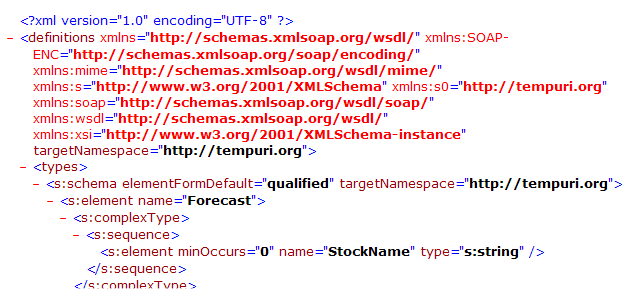
Important:
Not all browsers display the schema correctly. You might need to view the page source to see the actual schema. For example, in Firefox, right-click and then select View Source.
Generating the WSDL
You can also generate the WSDL as a static document. The %SOAP.WebService class provides a method you can use for this:
FileWSDL()
ClassMethod FileWSDL(fileName As %String, includeInternalMethods As %Boolean = 1) As %Status
Where fileName is the name of the file, and includeInternalMethods specifies whether the generated WSDL includes any web methods that are marked as Internal.
Suppressing Internal Web Methods from the WSDL
If the web service has web methods that are marked as Internal, by default the WSDL includes these web methods. You can prevent these methods from being included in the WSDL. To do so, do either of the following:
-
Use the FileWSDL() method of the web service to generate the WSDL; see the previous section. This method provides an argument that controls whether the WSDL includes internal web methods.
-
Specify the SOAPINTERNALWSDL class parameter as 0 in the web service class. (The default for this class parameter is 1.)
How To Create Soap Webservices In Java
Source: https://docs.intersystems.com/irislatest/csp/docbook/DocBook.UI.Page.cls?KEY=GSOAP_WEBSERVICE
Posted by: carrdidellp.blogspot.com
0 Response to "How To Create Soap Webservices In Java"
Post a Comment