

Would The Price Index Change If You Change The Makeup Of The Market Basket

"Aggrandizement is when you pay fifteen dollars for the ten-dollar haircut yous used to become for five dollars when you had pilus."
—Sam Ewing, Former professional baseball player
Does a dollar go as far as it used to? Information technology might seem that y'all're paying higher and college prices for the goods you buy. Nevertheless, the data show that inflation has been virtually nonexistent for much of 2015. And the inflation charge per unit has been lower than the Federal Reserve'due south ii percent inflation goal for more than than three years.1 However, when many people hear reports of lower-than-average inflation rates, they may non feel information technology reflects their feel as consumers. Where is the disconnect between the experience of individuals and what the data testify?
What Is Inflation?
By and large speaking, inflation ways the average level of prices is rise. More specifically, inflation is a general, sustained upward motion of prices for appurtenances and services in an economic system. Prices have tended to rise over fourth dimension, which means that the inflation rate (the percent increase in the average price level of goods over a period of time) has been positive. And, as prices ascent, the purchasing power of each dollar diminishes. A 2 percent inflation rate means that (on average) a dollar buys 2 percent fewer appurtenances and services than information technology did last year. Y'all might be surprised to discover that even after accounting for the event of rising prices (inflation), average incomes have risen over time.2 So, while information technology'due south true that prices generally ascent over time, and then do people'south incomes, which commonly allows them to purchase more goods and services.
Fifty-fifty though yous rarely find people discussing rising prices as an economical benefit, most economists believe that a low and stable charge per unit of inflation is benign for the economy.3 To this end, many key banks have a mandate of cost stability, which ways they are directed to intentionally generate a low and steady rate of inflation. The Federal Reserve Organization, the central banking system of the United states of america, has a dual mandate of price stability and maximum employment and has interpreted toll stability as a 2 percent inflation objective.4
How Is Aggrandizement Measured?
Inflation can be measured in a variety of ways, depending on which "basket" of prices is measured and how those prices are weighted. The most widely reported measure of aggrandizement is the consumer price index (CPI). The CPI measures the boilerplate change over time in the prices paid by urban consumers for a market basket of consumer goods and services. The current CPI market basket was synthetic based on input from spending diaries kept by 28,000 consumers and some other 60,000 quarterly interviews conducted in 2011 and 2012. All this information was used to determine what people were actually buying.five Data collectors visit places of business organization to collect price information monthly to record the prices of well-nigh eighty,000 items that brand up the market basket.6 The prices of goods and services in the market basket are and so "indexed" to brand it easier to compare changes in the price of the market basket over time. To practise this, the Bureau of Labor Statistics sets the price of the market basket during a detail time flow equal to "100." Changes in the index value are used to measure inflation and calculate the aggrandizement charge per unit. For example, if the index rises from 100 to 103 in a twelvemonth, the inflation rate for that 1-year period is 3 percentage. Likewise, notice the use of the give-and-take "urban"; the CPI is meant to reflect the purchases of the typical urban consumer, which represents about 87 percent of the U.South. population.7,8 People who live in rural nonmetropolitan areas, farm families, people in the war machine, and those in institutions are not included in the adding; therefore, the CPI does non attempt to reflect price changes for these consumers.
Your Personal Inflation Charge per unit
Statistics are often reported as an boilerplate, but that average might not reflect the experience of whatsoever given individual in the sample. For instance, the average age of a person living in the U.s.a. is 37.6 years9 and the average income is $46,163 (personal income per capita).x Are you 37.6 years old with an income of $46,163? Chances are y'all don't fit this average exactly. Similarly, your personal inflation charge per unit volition likely differ from the CPI inflation rate. The CPI market basket is an average calculated to reflect the spending of the average urban household, non whatever specific individual household.
Considering each private buys a different basket of appurtenances and services, potentially every person has his or her ain inflation rate. Your personal inflation rate depends on how you spend your money. For example, let's presume you hit the "average person" mark fairly closely: Yous are nearly 37.half dozen years sometime, born on Jan 1, 1978. During your lifetime, the prices of all items in the CPI market place basket have risen approximately 278 per centum (an boilerplate almanac charge per unit of iii.7 percent). However, when separated into categories, medical care has risen 653 percentage (an average annual rate of 5.6 percent), while clothes has risen simply 57 percent (an average annual rate of ane.3 percentage) since your birth. Yous tin can likely meet how your individual marketplace basket influences your personal aggrandizement rate (see the figure). If you have spent a larger portion of your income on medical care, for which the average price has risen faster than most prices, your personal inflation rate has been college than the CPI inflation rate. On the other manus, if your twin sis has spent a larger portion of her income on clothes, for which the average price has risen more than slowly than most prices, her personal aggrandizement charge per unit has been lower than the CPI inflation charge per unit.
NOTE: Equally stated in the essay, the average age of individuals in the United states is 37.six years. Assume here that the boilerplate person was born on January 1, 1978. Using FRED® to fix the index at 100 on that date, prices of all items in the CPI market place handbasket have risen approximately 278 percentage (blue line). However, when separated into categories, medical intendance has risen 653 percent (cerise line), while dress has risen only 57 per centum over that period (light-green line).
SOURCE: FRED®, Federal Reserve Economic Information, Federal Reserve Bank of St. Louis. Consumer Toll Index for All Urban Consumers: All Items, Medical Care, Apparel; https://research.stlouisfed.org/fred2/graph/?thou=1AxN.
The Everyday Toll Alphabetize
The Everyday Toll Index (EPI), published by the American Institute of Economical Enquiry (AIER), is designed to reflect price changes for the goods and services people buy frequently—at to the lowest degree once per calendar month. The index uses the CPI but but pulls the appurtenances and services purchased on a day-to-day basis out of the CPI basket and puts them into the EPI basket. In other words, it creates a smaller marketplace basket that includes only these everyday goods and services. Note that the EPI is not meant to reflect total consumer spending; rather, it is meant to reflect the "price changes felt by Americans on a day-to-day basis."11 The AIER tracks and reports monthly on the inflation charge per unit of this market basket.
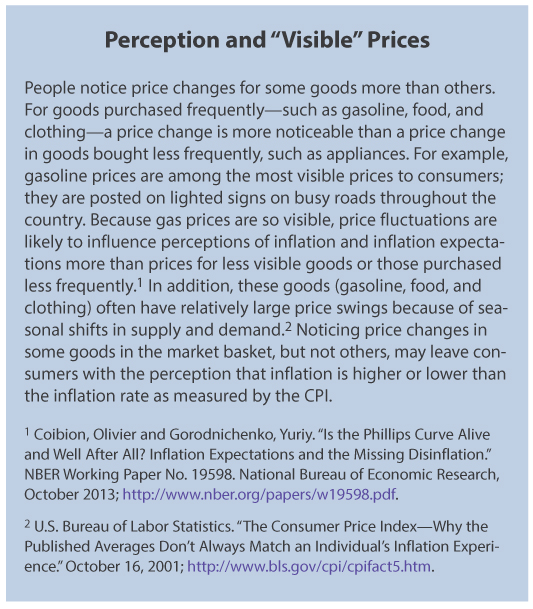
The EPI focuses on purchases that consumers cannot easily postpone or forgo (such as food, fuel, and prescription drugs). Consumers must absorb the fluctuations in prices as they happen. The largest categories in the EPI basket (comprising nigh half) are food at home (21.5 per centum), food away from dwelling (15.1 pct), and household fuels and utilities (13.4 percent).12 By contrast, the BLS gives those aforementioned categories much lower weights in the CPI market basket: food at home (eight.four pct), food away from home (v.8 percent), and household fuels and utilities (five.two percent).13 Goods such equally cars, appliances, and furniture are not included in the EPI simply considering they are not everyday goods. They are purchased infrequently, or consumers tin can sometimes delay the buy of these goods.xiv The EPI also excludes goods with prices fixed past contract, such every bit mortgage and rent payments, because consumers are protected from price increases during the contract menses. This smaller market basket is more volatile than the much larger CPI market basket. Over the by 20 years, the EPI indicates that everyday prices take risen by 76 percent (an boilerplate almanac rate of three.ii per centum), while the CPI indicates that prices have risen by 56 percent (an average almanac rate of 2.3 percent). The EPI might exist helpful in explaining the difference between the bodily (lower-than-average) inflation rate and the perception by many people that prices are rising rapidly. Differences in the visibility of certain prices might also impact your perception of inflation. For more than information, see the boxed insert, "Perception and 'Visible' Prices."
Determination
The CPI is designed to reverberate the purchases of the typical urban consumer, and non all people are typical or urban. More than importantly, the CPI is meant to reflect the feel of the boilerplate household, but differences in individual consumer choices most guarantee that the inflation rate experienced past any individual varies from the average aggrandizement charge per unit. In add-on, the prices of some goods that are more visible might influence people's perception of inflation because the prices are both noticeable and volatile. In brusque, it is adept to call back that when it comes to national statistics such as the CPI, actual (individual) results may vary.
Notes
1 "Inflation Misses Fed'south two% Target for 38th Directly Month." Real Fourth dimension Economics (weblog), Wall Street Periodical, August three, 2015; http://blogs.wsj.com/economic science/2015/08/03/inflation-misses-feds-2-target-for-38th-straight-month/.
ii Real dispensable income per capita in the United states of america has increased by 221 percent since April 1960 (see https://research.stlouisfed.org/fred2/graph/?grand=1sPx).
3 Economists prefer a minor "inflation buffer" to reduce the risk of deflation. For a more detailed give-and-take of inflation in the context of price stability, see Wolla, Scott A. "Coin and Inflation: A Functional Relationship." Federal Reserve Bank of St. Louis Page One Economics Newsletter, March 2013; https://inquiry.stlouisfed.org/publications/page1-econ/2013/03/01/money-and-inflation-a-functional-relationship/.
4 Board of Governors of the Federal Reserve System. "Press Release." January 25, 2015; http://world wide web.federalreserve.gov/newsevents/press/monetary/20120125c.htm. Notation: While the Federal Reserve considers many measures of inflation in its assessment of the economic system, its inflation objective is stated in terms of the personal consumption expenditures price index (PCEPI).
five U.South. Agency of Labor Statistics. "Consumer Price Index. FAQs: Question 6." Updated September 17, 2014; http://stats.bls.gov/cpi/cpifaq.htm#Question_6.
6 U.S. Bureau of Labor Statistics. "Consumer Cost Index. FAQs: Question 8." Updated September 17, 2014; http://stats.bls.gov/cpi/cpifaq.htm#Question_8.
vii U.South. Bureau of Labor Statistics. "Consumer Cost Index. FAQs: Question iii." Updated September 17, 2014; http://stats.bls.gov/cpi/cpifaq.htm#Question_3.
8 The Federal Reserve Bank of Atlanta offers a CPI tool that may more than accurately reflect an individual household'due south market basket. Its myCPI tool allows you to rail the prices of a market handbasket more similar yours and compare your CPI with the national average. See https://www.frbatlanta.org/research/inflationproject/mycpi.aspx.
9 Key Intelligence Agency. The World Factbook. Updated July 15, 2015; https://www.cia.gov/library/publications/the-world-factbook/geos/us.html.
10 FRED®, Federal Reserve Economic Data, Federal Reserve Bank of St. Louis. Personal Income Per Capita; https://research.stlouisfed.org/fred2/series/A792RC0A052NBEA.
eleven Cangero, Theodore; Delorme, Luke F. and Vlasenko, Polina. "Improving the Everyday Cost Index." May 16, 2014; https://www.aier.org/research/improving-everyday-price-index.
12 Cangero, Theodore. "Poultry and Eggs Atomic number 82 Food Prices College." July 17, 2015; https://www.aier.org/research/poultry-and-eggs-atomic number 82-food-prices-higher.
thirteen U.S. Agency of Labor Statistics. "Table ane (2011-2012 Weights). Relative Importance of Components in the Consumer Toll Indexes: U.S. City Average, December 2014." http://stats.bls.gov/cpi/cpiri_2014.pdf.
xiv Cangero, Theodore and Delorme, Luke F. "EPI Methodology." May xv, 2014; https://www.aier.org/research/epi-methodology.
© 2015, Federal Reserve Banking concern of St. Louis. The views expressed are those of the author(s) and do not necessarily reflect official positions of the Federal Reserve Bank of St. Louis or the Federal Reserve System.

Would The Price Index Change If You Change The Makeup Of The Market Basket,
Source: https://research.stlouisfed.org/publications/page1-econ/2015/10/01/whats-in-your-market-basket-why-your-inflation-rate-might-differ-from-the-average/
Posted by: carrdidellp.blogspot.com
0 Response to "Would The Price Index Change If You Change The Makeup Of The Market Basket"
Post a Comment